
Table of Contents
- What Are Braces for Kids?
- What Is the Right Age for Braces?
- 10 Things Every Parent Must Know About Braces for Kids
- Types of Braces for Kids
- How Much Do Braces for Kids Cost?
- Does Getting Braces Hurt?
- Foods Kids Cannot Eat With Braces
- How to Care for Braces at Home
- How Long Do Kids Need to Wear Braces?
- Life After Braces — Retainers
- Final Thoughts
What Are Braces for Kids? {#what-are}
Braces for kids are orthodontic devices that gradually shift teeth and jaws into proper alignment.
They are one of the most common dental treatments for children and teenagers worldwide — and for good reason.
Crooked teeth, overcrowding, overbites, underbites, and gaps between teeth are not just cosmetic problems. They can cause difficulty chewing, speech problems, jaw pain, and increased risk of tooth decay if left untreated.
Braces for kids fix these issues during the years when the jaw is still growing and the teeth are easiest to move — making childhood and early adolescence the ideal time for treatment.
📌 Did you know? According to the American Association of Orthodontists, over 4 million children in the United States alone are currently wearing braces.
What Is the Right Age for Braces for Kids? {#right-age}
One of the most common questions parents ask is: “When should my child get braces?”
The answer depends on the child — but here are the general guidelines:
First Orthodontic Check-Up: Age 7
The American Association of Orthodontists recommends that every child have their first orthodontic evaluation by age 7.
At this age, the first permanent molars and incisors have usually come in. An orthodontist can spot alignment issues early — even before all baby teeth have fallen out.
An early check-up does NOT mean braces for kids will start at age 7. It simply means the orthodontist can monitor development and plan treatment at the ideal time.
Most Common Age for Braces: 9 to 14
Most children get braces for kids between the ages of 9 and 14.
This is because:
- Most baby teeth have fallen out
- Permanent teeth are in place
- The jaw is still growing and highly responsive to correction
- Treatment at this age is faster and more effective than in adulthood
Adult Braces Are Also Possible
There is no age limit for orthodontic treatment. However, treatment in children is generally faster, less expensive, and more effective because the jaw is still developing.
10 Powerful Things Every Parent Must Know About Braces for Kids {#10-things}
Here are the 10 most important things to understand before your child starts braces for kids treatment.
1. Braces for Kids Are About Health — Not Just Appearance
Many parents think of braces for kids as a cosmetic treatment. But the health benefits go far beyond a straighter smile.
Properly aligned teeth are:
- Easier to brush and floss — reducing cavities and gum disease
- Less likely to chip or wear unevenly
- Better for proper chewing and digestion
- Less likely to cause jaw pain or TMJ issues in adulthood
2. Early Treatment Can Prevent Bigger Problems Later
Some orthodontic issues — like severe crowding or jaw misalignment — are much easier and cheaper to treat in children than in adults.
Phase 1 orthodontic treatment (ages 6–10) can guide jaw growth and create space for permanent teeth before they fully erupt.
Ignoring these issues can mean more complex and expensive treatment — including tooth extractions or jaw surgery — in adulthood.
3. Not Every Child Needs Braces at the Same Time
Every child’s dental development is unique. Just because your child’s friend got braces for kids at age 10 does not mean your child needs them at the same age.
Always follow your orthodontist’s recommendation based on X-rays, growth evaluation, and the specific issue being corrected.
4. There Are Several Types of Braces to Choose From
Braces for kids are not one-size-fits-all. There are multiple options depending on your child’s needs, age, and your family’s budget.
(See full types breakdown in the next section.)
5. Regular Orthodontist Visits Are Essential
Once braces for kids are fitted, your child will need to visit the orthodontist every 4 to 8 weeks for adjustments.
Missing appointments delays treatment and can cause problems. Plan your schedule around these visits — they are not optional.
6. Diet Changes Are Required
Children with braces must avoid certain foods that can break brackets or bend wires.
This is one of the biggest lifestyle adjustments for kids — especially those who love chewy candies, popcorn, or hard pretzels.
(Full list of foods to avoid is in the section below.)
7. Oral Hygiene Becomes More Important — and More Difficult
Food gets trapped around brackets and wires very easily. If not cleaned properly, braces for kids can lead to white spots (permanent enamel damage), cavities, and gum disease.
Your child will need to brush after every meal and floss daily using a floss threader or water flosser.
8. There Will Be Discomfort — But It Is Manageable
Braces for kids are not painless — especially in the first week and after each adjustment appointment.
But the discomfort is temporary and very manageable with:
- Over-the-counter pain relievers like ibuprofen
- Soft foods during the first few days
- Orthodontic wax on sharp brackets
- Warm salt water rinses
9. Treatment Length Varies
Most children wear braces for kids for 18 months to 3 years.
The exact length depends on:
- The severity of the misalignment
- The type of braces chosen
- How well the child follows care instructions
- Whether appointments are kept consistently
10. A Retainer Is Required After Braces
Once braces come off, the teeth do not stay in their new position on their own. A retainer must be worn — usually every night — to maintain the results.
Skipping retainer wear is the most common reason teeth shift back after braces for kids treatment.
Types of Braces for Kids {#types}
There are four main types of braces for kids available today:
Traditional Metal Braces
The most common type. Metal brackets are bonded to the front of each tooth and connected by a wire that is tightened at each appointment.
- ✅ Most effective for complex cases
- ✅ Most affordable option
- ✅ Available in fun colored rubber bands kids love
- ❌ Most visible option
Average cost: $3,000 – $7,000
Ceramic Braces
Same design as metal braces but brackets are tooth-colored or clear, making them far less noticeable.
- ✅ Less visible than metal
- ✅ Just as effective as metal
- ❌ Slightly more expensive
- ❌ Can stain if child eats certain foods
Average cost: $4,000 – $8,000
Lingual Braces
Brackets are placed on the back (tongue side) of the teeth — completely invisible from the front.
- ✅ Completely hidden
- ❌ More expensive
- ❌ Can affect speech temporarily
- ❌ Harder to clean
Average cost: $8,000 – $10,000
Clear Aligners (Invisalign Teen)
A series of removable, custom-made clear plastic trays that gradually shift teeth.
- ✅ Nearly invisible
- ✅ Removable for eating and brushing
- ❌ Requires discipline — must be worn 20–22 hours per day
- ❌ Not suitable for all cases
- ❌ More expensive
Average cost: $4,000 – $8,000
According to Healthline’s orthodontics guide, metal braces remain the most recommended option for children with moderate to severe alignment issues because of their reliability and cost-effectiveness.
How Much Do Braces for Kids Cost? {#cost}
The cost of braces for kids varies widely depending on:
- Type of braces chosen
- Severity of the case
- Your location
- Whether you have dental insurance
| Type | Average Cost (USA) |
|---|---|
| Metal braces | $3,000 – $7,000 |
| Ceramic braces | $4,000 – $8,000 |
| Clear aligners | $4,000 – $8,000 |
| Lingual braces | $8,000 – $10,000 |
Ways to reduce the cost:
- Dental insurance — many plans cover 50% of orthodontic treatment up to a lifetime maximum
- Flexible Spending Accounts (FSA/HSA) — use pre-tax dollars for orthodontic costs
- Payment plans — most orthodontists offer monthly payment plans with little or no interest
- Dental schools — orthodontic treatment at dental schools is often 30–50% cheaper
Does Getting Braces Hurt? {#pain}
This is the question every child asks — and the honest answer is: it can be uncomfortable, but it is not unbearable.
When braces are first put on: The process of fitting braces for kids takes 1–2 hours and is not painful during placement. However, in the 2–5 days after fitting, teeth will feel sore and tender.
After adjustment appointments: Every 4–8 weeks, the orthodontist tightens the wire. This causes mild to moderate soreness for 1–3 days.
How to help your child manage discomfort:
- Give children’s ibuprofen or acetaminophen before appointments
- Serve soft foods: yogurt, mashed potatoes, soup, smoothies
- Apply orthodontic wax over any sharp bracket edges
- Encourage warm salt water rinses twice a day
Most children adapt within the first month and barely notice their braces after that.
Foods Kids Cannot Eat With Braces {#foods}
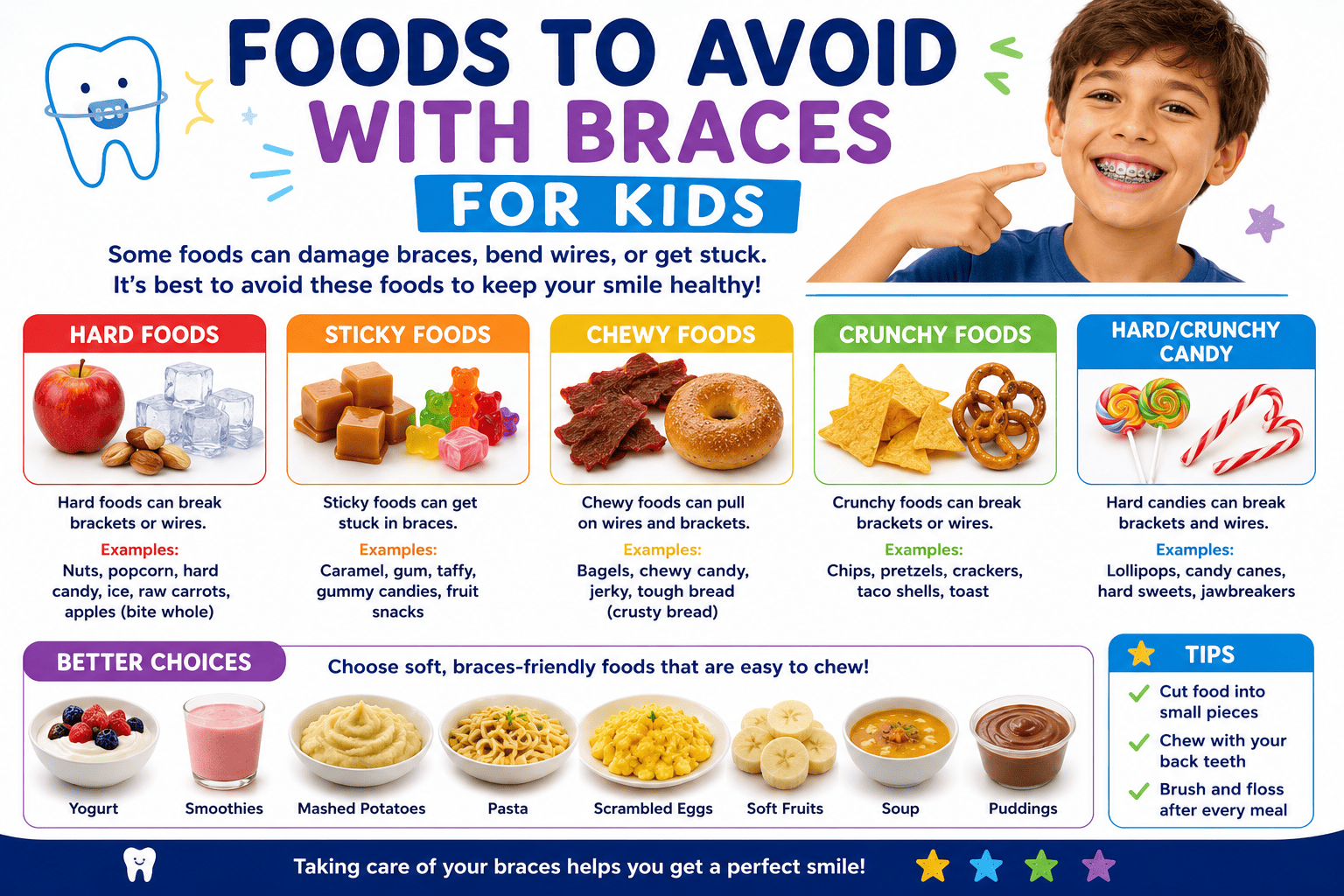
Diet is one of the most important parts of braces for kids care. The wrong foods can break brackets, bend wires, and extend treatment time.
❌ Foods to Avoid Completely
- Hard candy and lollipops
- Chewy candy (gummy bears, taffy, caramel)
- Popcorn
- Hard pretzels and chips
- Nuts
- Ice chewing
- Whole raw apples and carrots (cut into small pieces instead)
- Corn on the cob (cut corn off the cob)
- Bagels and hard rolls
- Pizza crust (the hard edges)
✅ Safe Foods for Kids With Braces
- Soft fruits: bananas, berries, grapes, melon
- Cooked vegetables
- Pasta and rice
- Soft bread and tortillas
- Dairy: yogurt, cheese, milk
- Eggs prepared any way
- Soft meat: chicken, fish, ground beef
- Ice cream and smoothies (in moderation)
For more ideas on nutrition for children, check out our guide on healthy snacks for kids.
How to Care for Braces at Home {#care}
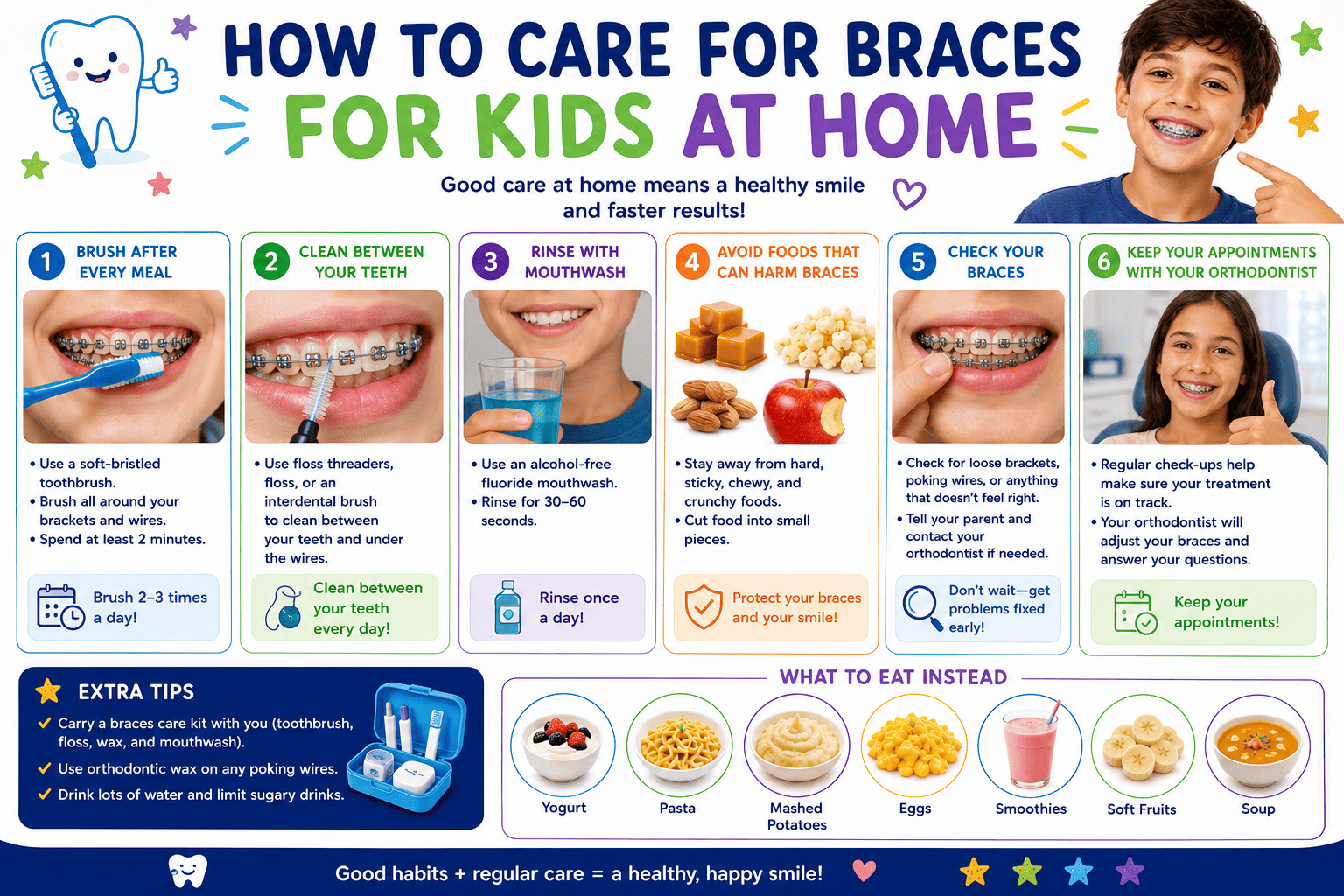
Good oral hygiene is critical during braces for kids treatment.
Daily Braces Care Routine for Kids
Morning:
- Brush teeth and braces thoroughly for 2 minutes
- Use a soft-bristled toothbrush or electric brush
- Brush at a 45-degree angle above and below brackets
- Rinse with fluoride mouthwash
After Every Meal:
- Rinse mouth with water immediately
- Brush if possible — carry a travel toothbrush
- Check mirror for food stuck in brackets
Before Bed:
- Brush teeth thoroughly for 2 full minutes
- Floss using a floss threader, orthodontic flosser, or water flosser
- Rinse with fluoride mouthwash
Tools That Help
- Interdental brushes — tiny brushes that clean between brackets
- Water flosser — easier than string floss for children
- Orthodontic wax — soothes irritation from sharp brackets
- Travel toothbrush kit — for brushing at school after lunch
How Long Do Kids Need to Wear Braces? {#how-long}
The average treatment time for braces for kids is 18 months to 3 years.
Factors that affect treatment length:
- Severity of misalignment — minor crowding may take 12 months; complex cases may take 3 years
- Age — younger jaws respond faster to treatment
- Compliance — following dietary rules and keeping appointments speeds up treatment significantly
- Type of braces — some cases respond faster to certain types
Your orthodontist will give you an estimated treatment timeline at the consultation. Most children finish treatment within 2 years.
Life After Braces — Retainers {#retainers}
After braces for kids are removed, the treatment is not over.
Teeth have a natural tendency to shift back to their original position — a process called relapse. The only way to prevent this is consistent retainer wear.
Types of Retainers
Fixed retainer: A thin wire bonded permanently to the back of the front teeth. The child never has to remember to wear it.
Removable retainer: A clear plastic tray (similar to an Invisalign aligner) worn every night. Must be worn consistently or teeth will shift.
Most orthodontists recommend wearing a removable retainer every night indefinitely. The good news: after the first year, most children only need to wear it while sleeping.
According to the Mayo Clinic’s orthodontic guide, skipping retainer use is the single most common reason orthodontic results do not last.
Final Thoughts {#final}
Braces for kids are one of the most impactful investments you can make in your child’s long-term health and confidence.
A straight, healthy smile is not just about looking good — it affects how children eat, speak, breathe, and feel about themselves.
The process takes time and patience. There will be sore days, dietary adjustments, and extra brushing. But the results — a healthy, confident smile that lasts a lifetime — are absolutely worth it.
If you are unsure whether your child needs braces, book a consultation with an orthodontist. The first evaluation is usually free — and the earlier you start monitoring, the better the outcome.
Your child’s smile is worth it. 😊
📌 Also Read on Nature Nestia:
- Healthy Snacks for Kids: 25 Best Ideas
- Why Kids Are Stubborn: 10 Reasons & Best Solutions
- 50 Best Things to Do With Kids at Home
- Best Parenting Books in 2026
Is your child getting braces soon? Drop your questions in the comments — we are here to help!
