
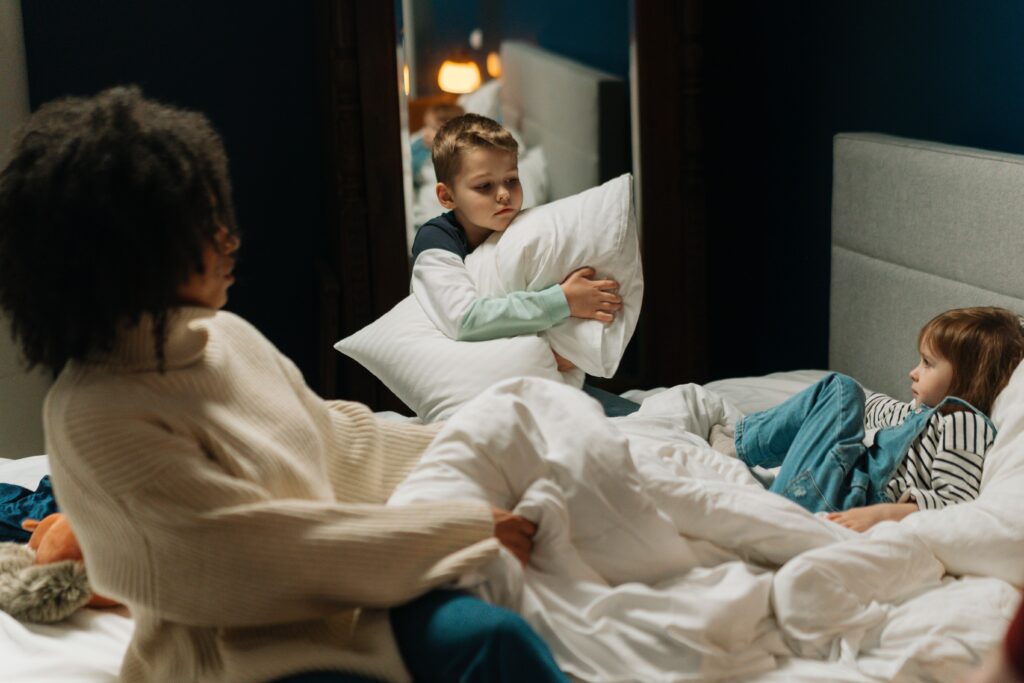
There was a stretch, somewhere between my older one turning three and my younger one arriving, when 7:30 PM stopped feeling like bedtime and started feeling like a countdown to a fight. Not a dramatic one. Just the quiet, exhausting kind — “one more story,” “I need water,” “my leg feels weird,” “I’m not tired” (said while rubbing both eyes). Some nights it took forty minutes. Some nights it took two hours. I remember sitting on the hallway floor outside his door at 9:15 one night, back against the wall, wondering why something every parent on earth has done for thousands of years suddenly felt impossible for me.
If you’re in that phase right now, I want to say this before anything else: it’s not a sign you’re doing something wrong. It’s just a genuinely hard stretch, and it usually passes faster than it feels like it will.
What I Tried First (And Why It Didn’t Work)
My first instinct was to make the routine stricter. Earlier bath, dimmer lights, a hard cutoff on stories — one, no negotiating. On paper it looked like good advice, the kind you’d read anywhere. In practice, it made things worse, because the stricter I got, the more he pushed back. Bedtime turned into a small negotiation every night, and negotiations he was, frankly, very good at.

Then I swung the other way and got permissive. Extra stories if he asked nicely, staying in the room until he fell asleep, letting him wander into our bed at 2 AM without much resistance. That fixed the fighting almost immediately — and created a new problem. He stopped being able to fall asleep without me in the room at all, even for naps. I’d traded one struggle for a longer, quieter one.
Looking back, both approaches were missing the same thing: I was trying to control the outcome (him being asleep by a certain time) instead of the actual issue, which was that he didn’t feel ready to be alone yet.
The Small Thing That Actually Shifted Things
What ended up helping wasn’t a new rule. It was giving him a small amount of control inside a routine that stayed exactly the same every night.
He got to choose the story. He got to choose which stuffed animal “slept on guard.” He got to choose whether the door was open a crack or closed. Everything else — bath, brush teeth, two songs, lights off — stayed identical, night after night, in the same order, at roughly the same time.
The American Academy of Pediatrics has pointed out that predictability itself helps children’s bodies anticipate sleep, almost like the routine becomes a cue on its own. That matched what I was seeing. It wasn’t that he suddenly loved bedtime. It was that his body seemed to know, by the second song, what was coming next, and there was less to resist.
It took about two weeks before the change felt real, not two nights. I want to be honest about that, because a lot of what I’d read made it sound instant, and when it wasn’t instant for us, I assumed I was doing it wrong.

What I’d Tell a Friend Going Through This Right Now
If your child is fighting bedtime, the first question I’d actually ask is whether the fight is about the room, or about missing you. Mine was almost entirely the second one. Once I understood that, “go to sleep” stopped being the right instruction, and “you’re safe, I’m right outside, you don’t need me in the room to be okay” became the more useful one — even though it took a while to be true.
The second thing I’d say: pick one thing to hold firm on, and let almost everything else flex. For us that one thing was the order of the routine. Bath, teeth, story, songs, lights — always in that sequence. The story length, the song choice, whether he wanted to talk about his day first — all of that could move around without breaking anything.
And the third thing, the one I needed to hear most at the time: a hard bedtime phase doesn’t mean something is wrong with your child, or with your parenting. Sleep researchers who study early childhood generally describe bedtime resistance around ages two to five as developmentally typical, tied to separation and a growing (sometimes overwhelming) sense of independence — not a discipline problem to be corrected.

What Didn’t Work, Even Though It’s Common Advice
For us, reward charts backfired. My son got so focused on whether he’d “earned” the sticker that bedtime became more anxious, not less — he’d ask about the chart before he’d even gotten into pajamas. I know charts work well for a lot of families, so I’m not saying skip them. I’m saying if you try one and it makes things more tense instead of less, that’s real information, not a failure on your part.
Cutting naps also didn’t solve it the way I expected. I’d read that an overtired child sleeps worse, so I assumed a wired, still-slightly-tired child would sleep better. What actually happened was a more overtired, harder-to-settle bedtime. Every child’s nap-to-bedtime math is different, and it took real trial and error — not a rule from an article — to find his.
Where We Are Now
Bedtime still isn’t instant. There are nights it takes fifteen minutes and nights it takes forty. But it stopped being a fight, which was really the only thing I actually wanted fixed. My younger one is approaching the same age now, and I can already feel the same pattern starting — which tells me this wasn’t really about my older son specifically. It was about a stage every young child seems to move through, in their own time, at their own pace.
If you’re in the middle of it tonight, sitting on a hallway floor of your own: it gets easier. Not because you find the perfect trick, but because you find the one or two things that work for your specific kid, and you stop expecting the rest to look like everyone else’s routine.
Aina Arif is a mother of two and the founder of NatureNestia. She writes about the parts of parenting that don’t always make it into the parenting books.

Aina Arif is a mother of two young children and the founder of NatureNestia. Based in Pakistan, she spent three years as an early childhood educator before becoming a full-time parent and writer. She writes about learning through play, managing difficult behaviour, and building strong family bonds.