You have seen them all over TikTok and Pinterest — beautiful wooden toys, trays of beans, and children fully absorbed in quiet, focused play. Montessori activities are everywhere right now, and for good reason. The great news? You do not need an expensive classroom setup or special toys to bring Montessori learning into your home. This guide shows you how to start today, using things you already have.
What is Montessori learning?
Montessori is a child-led approach to learning developed by Dr. Maria Montessori over 100 years ago. The idea is simple: children learn best when they are free to explore, make choices, and work with their hands at their own pace. Instead of sitting and listening, children do. Instead of being corrected, they discover. The result is deep focus, strong independence, and a genuine love of learning.
The 4 core Montessori principles
Child-led pace
Let the child decide how long to spend on an activity
Hands-on learning
Touch, sort, pour, build — the hands teach the brain
Prepared environment
Simple, organised spaces help children focus and choose freely
Independence first
Ask “can they do it themselves?” before jumping in to help
10 easy Montessori activities to try at home today
1. Pouring and transferring
Set up two small bowls and a jug of water (or a spoon for dry beans). Let your child pour back and forth. This builds hand control, concentration, and coordination — and children absolutely love the repetition. Put a tray underneath to catch spills and make cleanup easy.
You need: Two bowls, a small jug, water or dried beans
2. Sorting by colour or size
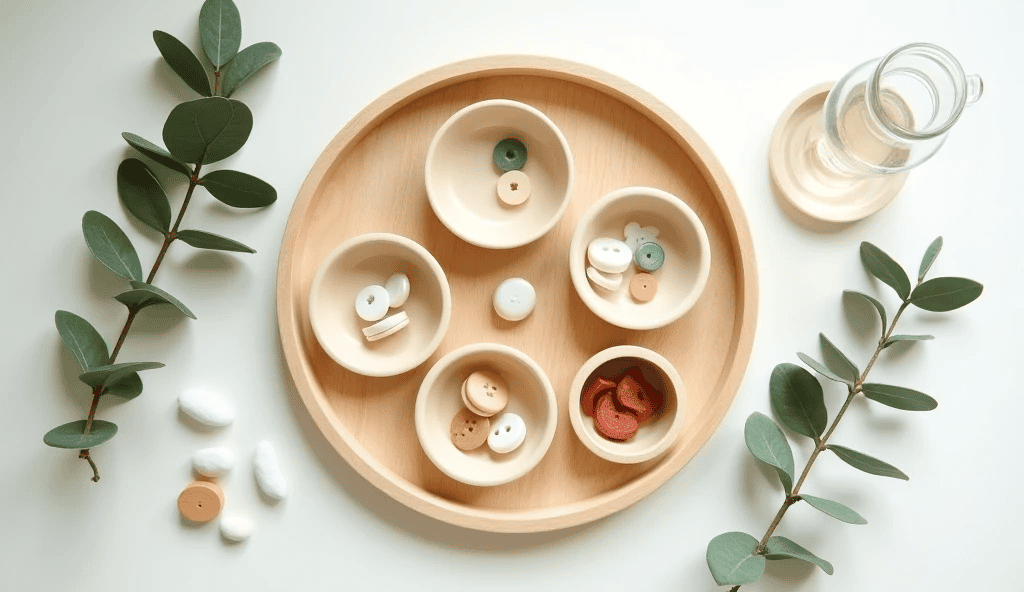
Gather everyday objects — buttons, bottle caps, socks, blocks — and ask your child to sort them into groups. No instruction needed; just put out a tray and let curiosity take over. Sorting teaches early math concepts like categorisation, patterns, and comparison without a single worksheet.
You need: Mixed household objects, a muffin tray or small bowls
3. Sweeping and cleaning
Give your child a small brush and dustpan and let them sweep up a pile of dried rice or crumbs you have made on purpose. Montessori views real household tasks as powerful learning opportunities. Children feel proud, capable, and genuinely helpful — which builds self-esteem in a way that toys simply cannot.
You need: Small brush, dustpan, a handful of dried rice
4. Sensory bin exploration
Fill a deep tray with kinetic sand, dried pasta, rice, or soil and hide small objects inside. Let your child dig, scoop, and discover. Sensory bins are huge on TikTok and Pinterest right now because they keep toddlers focused for 20–30 minutes — longer than almost any other activity at this age.
You need: A deep tray, dried rice or pasta, small toys or objects to hide
5. Object-to-picture matching
Print or draw simple pictures of everyday objects — a spoon, an apple, a shoe. Place the real objects next to the pictures and let your child match them. This builds vocabulary, visual recognition, and early reading readiness in a completely natural, stress-free way.
You need: Printed pictures, matching real objects from around the house
6. Number and quantity matching
Write numbers 1 to 10 on small pieces of paper. Ask your child to place the correct number of small objects — stones, buttons, pasta pieces — next to each number. This is one of the most shared Montessori math activities on Pinterest because it is simple, visual, and deeply effective for building number sense.
You need: Paper, marker, small countable objects
7. Sandpaper letter tracing
Cut letters out of sandpaper and glue them onto cardboard. Let your child trace each letter with two fingers while you say the sound together. The texture creates a strong sensory memory that helps children learn letter shapes much faster than pencil practice alone. You can make the whole alphabet over a weekend.
You need: Sandpaper, cardboard, scissors, glue
8. Nature tray collection
Go on a short walk and collect natural items — leaves, stones, feathers, seed pods, bark. Arrange them on a tray at home and explore them together. Observe, sort, and talk about what you find. Montessori strongly emphasises nature connection, and this activity fits perfectly with the Nature Nestia ethos.
You need: A tray, a short walk outside
9. Lacing and threading
Thread pasta tubes or cut holes in cardboard shapes and let your child lace string or a shoelace through them. This builds the hand-eye coordination and pincer grip that children need for writing — and it looks beautiful on a tray, making it irresistible to curious little hands.
You need: Cardboard, a hole punch, string or a shoelace
10. Simple food preparation
Let your child wash fruit, peel a banana, spread butter on bread, or tear lettuce for a salad. Real kitchen tasks are among the most powerful Montessori activities because they combine fine motor skills, sequencing, responsibility, and the reward of eating what you made — all in one go.
You need: Safe kitchen tools, simple ingredients
Parent tip: You do not need to buy anything special to start. Look around your home — a muffin tray, some dried beans, a jug, and a tray are enough to set up five Montessori activities today. The magic is in the simplicity, not the price tag.
How to set up a simple Montessori space at home
- Use a low shelf or tray that your child can access independently without asking for help
- Keep only 3 to 5 activities on the shelf at a time — too many choices causes overwhelm
- Rotate activities every week or two to keep curiosity fresh
- Store each activity in its own tray or basket so the child can take it out and put it back easily
- Keep the space tidy and beautiful — children are drawn to order and calm environments
- Observe more, instruct less — let your child figure things out before you step in
Why Montessori works — what the research says
Studies consistently show that children in Montessori environments develop stronger executive function, better reading and math skills, and higher levels of creativity and social skills compared to children in traditional classroom settings. But perhaps the most important outcome is this: they learn to love learning. And that love stays with them for life.
Montessori at home does not have to be perfect or Pinterest-worthy. It just has to give your child the space to explore, the freedom to choose, and the joy of doing things for themselves. Start with one activity from this list today and watch what happens. You might be surprised at how long they stay focused — and how proud they look when they finish.
Happy learning, one tray at a time. 🌿

“I’m Aina Arif, a mama of boy and early childhood education enthusiast. At Nature Nestia, I share fun, simple learning activities that help children grow through play. Based in Pakistan, helping parents worldwide.”
Pingback: How to teach kids about plants and seeds at home – a fun hands-on guide - Nature Nestia