
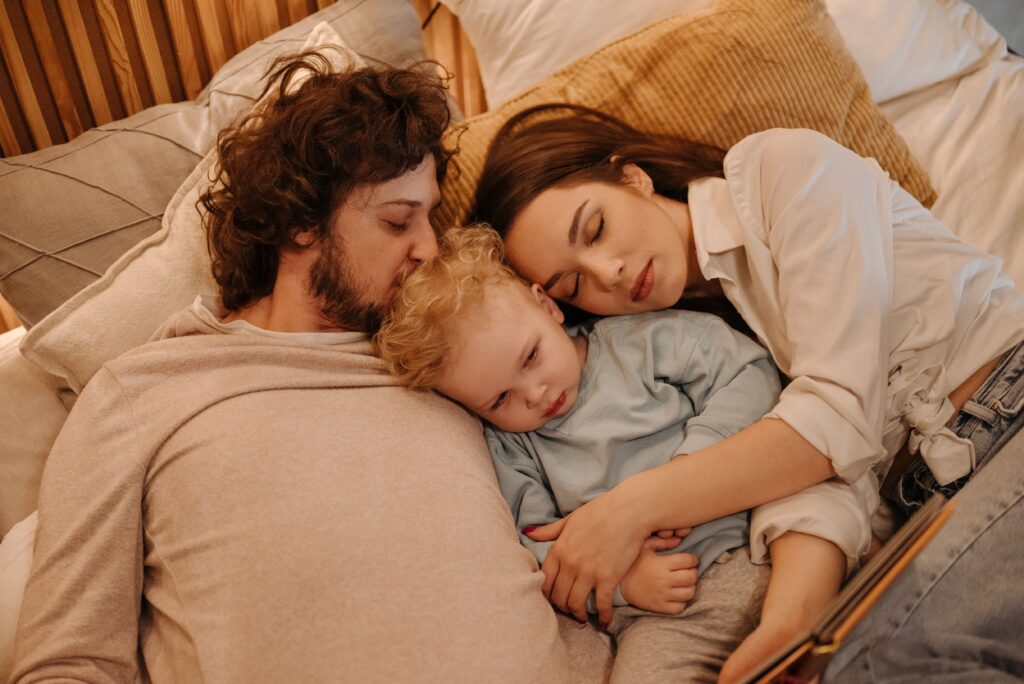
It’s 11:47 PM, and I am, once again, lying in the narrow strip of bed my toddler has left me, one arm gone numb, staring at the ceiling and wondering how a person this small can take up this much space. If you’ve found this because you’re in a similar position — exhausted, googling this exact question at an hour you’re not proud of — I want to start by saying: you’re not doing anything wrong, and this is more common than the parenting accounts online with perfectly sleeping children would have you believe.
I’ve spent a long time trying to figure out why my toddler won’t sleep alone, and I don’t have a single tidy answer. What I have instead is everything I’ve actually learned, tried, and lived through, which I think is more useful than a list of tips from someone who hasn’t been in the room at 2 AM.
It’s Usually Not About the Bed
My first instinct, when this started, was to assume it was a comfort or setup problem. Maybe the room was too dark, or not dark enough. Maybe the mattress was uncomfortable. Maybe we needed a different night light, a different blanket, a different everything. I spent an embarrassing amount of money trying to solve this with products before I accepted that the issue wasn’t really about the physical space at all.
What I’ve come to understand, after talking to other parents and eventually our pediatrician, is that a toddler not wanting to sleep alone is very rarely about the room itself. It’s almost always about a need for connection and safety that doesn’t switch off just because the lights go out. Toddlers are still developing a sense that the world, and the people in it, remain reliable and present even when they can’t see them. Sleep, for a toddler, means separating from you for hours in a row, in the dark, with no way to check that you’re still there. For an adult, that’s routine. For a toddler, it can genuinely feel like a big ask.
The Age Factor Nobody Warned Me About
Something I wish someone had told me earlier: this isn’t necessarily a phase you “fix” once and it’s done forever. My toddler slept independently for a stretch around eighteen months, and I remember feeling like we’d cracked it. Then, a few months later, seemingly out of nowhere, the resistance to sleeping alone came back, stronger than before.
It turned out this wasn’t a step backward so much as a normal part of development. Around age two, and again around age three, kids go through waves of increased awareness — of separation, of the dark, of their own imagination, which starts producing far more vivid fears than it used to. A toddler who slept fine at eighteen months might genuinely struggle at two and a half, not because anything went wrong, but because their inner world got more complicated.
What I Tried That Didn’t Work
I want to be honest about the things I tried that backfired, because I think it’s more useful than pretending I found the perfect solution on the first attempt.
I tried simply leaving my toddler to “cry it out” alone in the room, on the advice of a well-meaning relative who insisted this was how every generation before mine had done it. It didn’t work for us. The crying escalated instead of resolving, and I ended up going in anyway, which meant we’d both had a distressing experience for nothing.
I also tried the opposite extreme for a while — staying in the room until my toddler fell fully asleep every single night, sitting on the floor next to the bed for sometimes forty minutes at a stretch. This worked in the sense that it got my child to sleep, but it created a dependency that made things harder later, because waking up in the middle of the night without me there in the exact same spot became its own source of distress.
Neither extreme worked. What eventually helped was something in between, and it took a while to get there.

What Actually Helped, Slowly
The first real shift was separating the ideas of “falling asleep” and “being alone.” Instead of trying to get my toddler to fall asleep completely independently right away, I started sitting in a chair near the door instead of right beside the bed, slightly further away each week. It felt almost too slow at first, but the gradual distance seemed to matter more than any single technique.
I also started being very consistent about a short, predictable routine before bed — the same two books, the same few sentences, the same order of events every night. I’d read that unpredictability itself can make separation harder for toddlers, because part of what makes being alone frightening is not knowing what’s coming next. A routine that’s exactly the same every night, even a short one, seems to give a sense of safety that a longer but inconsistent one doesn’t.
One thing that helped more than I expected was naming the fear out loud instead of dismissing it. Early on, my instinct was to say things like “there’s nothing to be scared of” when my toddler said the room felt scary alone. It never worked, and looking back, I understand why — it doesn’t actually address what the child is feeling, it just tells them their feeling is wrong. Switching to something like “it’s okay to feel a little scared, I’m right outside, and I’ll check on you” seemed to land very differently. It didn’t eliminate the fear, but it made my toddler feel heard instead of dismissed, which seemed to lower the intensity of the resistance overall.
The Night Terror Scare
There was one stretch, a few weeks into all of this, where my toddler started waking up screaming in a way that was different from the usual resistance to being alone — eyes open, seemingly awake, but not really responsive to me, and not calming down the way a normal wake-up would. That frightened me more than anything else in this whole process, and I called our pediatrician the next morning.
She explained that this sounded like night terrors, which are a different thing from a toddler simply not wanting to sleep alone, and are actually fairly common at this age, usually more distressing for the parent watching than dangerous for the child. She recommended not trying to fully wake my toddler during these episodes, just staying nearby to make sure they were safe until it passed. It was reassuring to have a name for what was happening, and to understand it wasn’t connected to anything I was doing wrong with the sleep-alone process. It did make me more cautious about pushing too hard on independent sleep during that particular stretch, and I think that patience was the right call.
What I’d Tell a Friend Going Through This Right Now
If a friend came to me exhausted, asking why her toddler won’t sleep alone, here’s what I’d actually say, instead of a tidy list of tips.
It’s not a reflection of anything she’s doing wrong as a parent, even though it feels that way at 11 PM on a hard night. Toddlers move backward and forward through independence at this age in ways that don’t always make logical sense from the outside — a child who slept alone easily last month might genuinely struggle this month for reasons that have nothing to do with parenting choices.
Consistency matters more than any specific technique. Whatever approach she chooses, sticking with it for more than a few nights matters more than finding the “right” one, because toddlers need repetition to feel safe with a new pattern.
And some of it just takes time. Not every parenting challenge has a fast solution, and this is one of the ones that, in my experience, mostly resolves gradually rather than all at once.
Quick Answers to What People Usually Ask Me
Is it normal for a toddler to suddenly stop sleeping alone after doing it fine for months? Yes, in my experience and from what our pediatrician confirmed, this is common around developmental leaps — particularly close to age two and again near age three. It’s usually not a sign that something has gone wrong.
Should I let my toddler cry it out to fix this? It didn’t work for us, and it made things worse before they got better. That doesn’t mean it never works for any family, but if it’s escalating rather than resolving after a couple of nights, it’s worth trying a gentler, more gradual approach instead.
How long does a sleep-resistance phase usually last? There’s no fixed timeline. For us, the gradual “chair moving further from the bed” approach took a few weeks to fully work, and even now, months later, it occasionally resurfaces during big changes or stressful stretches.
When should I actually call the pediatrician about this? If what’s happening doesn’t look like ordinary resistance to being alone — like screaming that doesn’t respond to your presence, seeming genuinely unreachable during an episode, or any new pattern that worries you — it’s worth a call. That’s exactly what led us to learn about night terrors, and having a name for what was happening made a real difference in how we handled it.
Where We Are Now
My toddler sleeps independently most nights now, though “most” is doing some work in that sentence — there are still nights, especially after a big change in routine, a new sibling, or just an off day, where the resistance comes back for a stretch. I’ve stopped expecting this to be a problem I solve permanently and started thinking of it more as something we move through in waves, together.
If you’re reading this at some exhausted hour, wondering what you’re doing wrong, I don’t think you’re doing anything wrong. I think you have a small person who still needs to feel like the world is safe and predictable before they can let go of you for a whole night, and that need doesn’t move on your schedule. It moves on theirs, slowly, and usually quieter than you’d expect once it finally does.
Has your toddler gone through a phase of resisting sleep? I’d love to hear what’s helped in your house — contact me here.

Aina Arif is a mother of two young children and the founder of NatureNestia. Based in Pakistan, she spent three years as an early childhood educator before becoming a full-time parent and writer. She writes about learning through play, managing difficult behaviour, and building strong family bonds.
Great content! Keep up the good work!
Thanku..