
By Aina Arif | Updated: June 2026 | 13 min read
Why Big Movements Matter More Than You Think
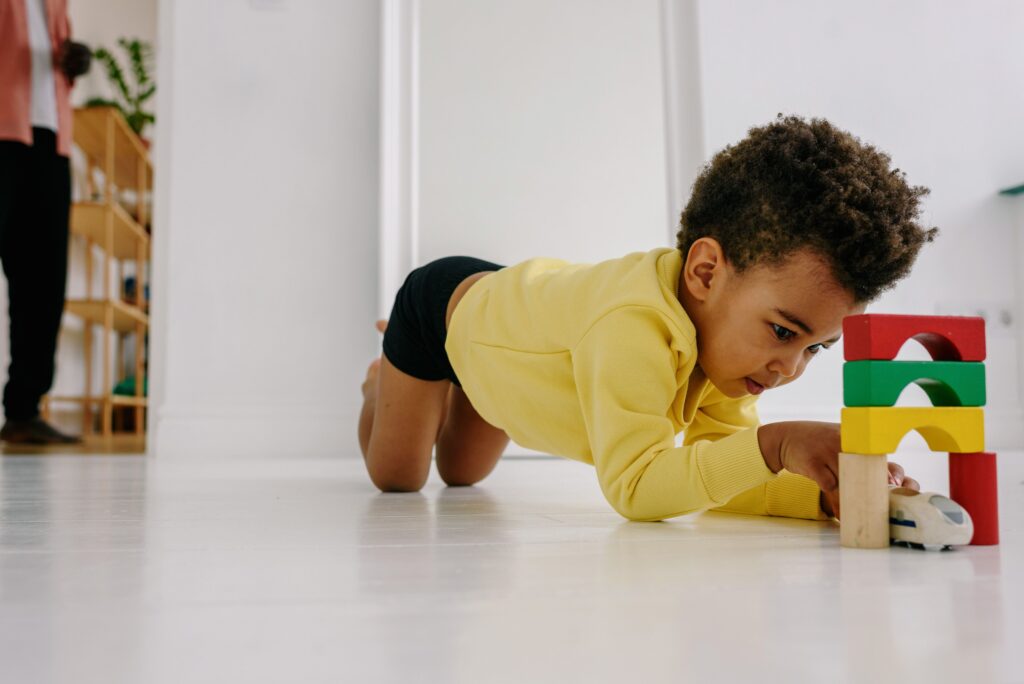
When toddlers run across the living room, crawl under a table, or jump with excitement, it may look like they’re simply burning energy.
In reality, they’re doing something much more important.
Every climb, stretch, kick, and hop helps strengthen muscles, improve coordination, and build the confidence needed for everyday activities.
These are called gross motor skills—the large body movements that allow children to walk, run, balance, climb, throw, and explore their world safely.
The good news?
You don’t need a playground or expensive equipment to encourage these skills.
Your home is already full of opportunities for active learning.
Welcome to the Move of the Day Challenge, where each mission helps your toddler grow stronger while having fun.
🦶 Move of the Day #1: Balance Builder
Today’s Mission
Can your toddler become a tightrope walker without leaving the living room?
How to Set It Up
Place painter’s tape in a straight line across the floor.
Invite your toddler to walk carefully along the line without stepping off.
Once they’ve mastered a straight path, try creating:
- Curved lines
- Zigzags
- Circles
- Figure-eight shapes
For extra excitement, pretend the floor is a river and the tape is a bridge.
Skills Growing Today
- Balance
- Body control
- Concentration
- Coordination
Easy Level
Hold your toddler’s hand while they walk.
Next-Level Challenge
Ask them to carry a soft toy while balancing.
Coach’s Corner
Avoid rushing.
Slow, controlled movements help develop balance more effectively than walking quickly.
🏃 Move of the Day #2: Speed Explorer
Today’s Mission
It’s time for a mini indoor race.
But instead of racing against others, your toddler races against fun challenges.
How to Set It Up
Create a short movement path around your home.
For example:
- Run to the sofa.
- Walk backwards to the chair.
- Tiptoe to the door.
- Crawl back to the starting point.
Each movement encourages a different skill.
Skills Growing Today
- Agility
- Coordination
- Direction following
- Body awareness
Easy Level
Use only two movement instructions.
Next-Level Challenge
Add simple commands like:
- Spin once.
- Clap three times.
- Jump before finishing.
Coach’s Corner
Celebrate effort instead of speed.
Confidence grows when children enjoy movement rather than competition.
🐻 Move of the Day #3: Animal Motion Adventure
Today’s Mission
Today’s living room has become a wildlife park.
Your toddler’s mission is to move like different animals.
How to Set It Up
Call out different animals and copy their movements together.
Ideas include:
- Bear walk
- Frog jumps
- Crab walk
- Penguin waddle
- Snake slither
- Elephant stomps
Take turns choosing the next animal.
The sillier the movements become, the more laughter fills the room.
Skills Growing Today
- Core strength
- Flexibility
- Coordination
- Imagination
Easy Level
Practice one animal at a time.
Next-Level Challenge
Create a short animal parade using four or five different movements.
Coach’s Corner
Children learn best when parents join the game.
Your participation makes movement feel like family fun instead of exercise.
🌟 Mission Progress Tracker
Don’t worry about completing every challenge today.
If your toddler has enjoyed moving, laughing, and trying something new, you’ve already achieved the goal.
Small moments of active play repeated every day make the biggest difference.
🎈 Move of the Day #4: Up & Down Challenge
Today’s Mission
Can your toddler explore different levels using safe movements?
How to Set It Up
Place soft cushions around the room.
Encourage your child to:
- Step onto a cushion.
- Step back down.
- Reach up high.
- Squat down low.
- Stretch toward the ceiling.
Add playful instructions such as:
“Can you touch the clouds?”
“Now pick up the tiny pebble!”
Pretend play makes every movement more exciting.
Skills Growing Today
- Leg strength
- Balance
- Body awareness
- Coordination
Easy Level
Practice stepping on and off one cushion.
Next-Level Challenge
Create a small stepping path using several cushions.
Coach’s Corner
Always use stable cushions on a non-slip surface and stay close for support.
⚽ Move of the Day #5: Kick & Chase
Today’s Mission
Today’s goal is to become a soccer superstar.
How to Set It Up
Use a soft foam or fabric ball.
Create a simple goal using two cushions or empty boxes.
Encourage your toddler to:
- Kick the ball toward the goal.
- Chase it.
- Bring it back.
- Try again.
Celebrate every successful kick with lots of encouragement.
Skills Growing Today
- Leg coordination
- Balance
- Timing
- Spatial awareness
Easy Level
Roll the ball gently toward your toddler.
Next-Level Challenge
Move the goal farther away or add simple obstacles.
🎯 Move of the Day #6: Throw & Aim
Today’s Mission
Can your toddler become a target champion?
How to Set It Up
Place a laundry basket a short distance away.
Provide soft balls, rolled-up socks, or beanbags.
Invite your child to throw each item into the basket.
Count successful throws together.
Skills Growing Today
- Hand-eye coordination
- Arm strength
- Focus
- Distance awareness
Easy Level
Stand close to the basket.
Next-Level Challenge
Move farther away after every successful throw.
Coach’s Corner
Large targets help toddlers experience success, keeping them motivated to keep trying.
📈 This Week’s Movement Scoreboard
Instead of completing every activity in one afternoon, spread them across the week.
| Day | Movement Mission |
|---|---|
| Monday | Balance Builder |
| Tuesday | Speed Explorer |
| Wednesday | Animal Motion Adventure |
| Thursday | Up & Down Challenge |
| Friday | Kick & Chase |
| Saturday | Throw & Aim |
| Sunday | Choose Your Favorite Challenge |
The goal isn’t perfection.
It’s helping your toddler discover that moving their body is exciting, healthy, and fun.
Tiny Victories Count
Your toddler doesn’t need to jump the highest or run the fastest.
Every careful step across a tape line…
Every giggle during a frog jump…
Every successful throw into the basket…
These little achievements are quietly building stronger muscles, better coordination, and greater confidence for the adventures ahead.
Move of the Day #7: Climb & Crawl Quest
Today’s Mission
Today’s challenge is all about exploring different paths.
Instead of walking from one place to another, your toddler will crawl, climb, and squeeze through safe obstacles.
How to Set It Up
Create a simple indoor adventure course using items you already have.
You can include:
- Cushions to crawl over
- A blanket tunnel under a table
- A pillow to climb across
- A chair to carefully walk around
- A finish line made with painter’s tape
Encourage your toddler to complete the course at their own pace.
Remember, the adventure matters more than the finish.
Skills Growing Today
- Core strength
- Bilateral coordination
- Motor planning
- Confidence
Easy Level
Create only two obstacles.
Next-Level Challenge
Ask your toddler to carry a stuffed toy through the course without dropping it.
Coach’s Corner
Change the obstacle course every few days.
Even moving one cushion creates a completely new adventure.
💃 Move of the Day #8: Rhythm in Motion
Today’s Mission
Can your toddler move to different rhythms?
Music encourages children to explore movement in creative ways while improving coordination and listening skills.
How to Set It Up
Play cheerful children’s songs or instrumental music.
Invite your toddler to:
- Dance freely
- Clap to the beat
- Spin slowly
- March around the room
- Freeze when the music stops
Keep the focus on fun rather than following perfect movements.
Skills Growing Today
- Rhythm awareness
- Listening
- Balance
- Coordination
- Self-control
Easy Level
Dance together while holding hands.
Next-Level Challenge
Change the movement whenever the music changes speed.
Coach’s Corner
Toddlers enjoy copying adults.
Don’t worry about looking silly—your enthusiasm encourages their confidence.
🧺 Move of the Day #9: Helper on the Move
Today’s Mission
Who says household chores can’t become active play?
Simple daily tasks provide excellent opportunities for movement.
How to Set It Up
Invite your toddler to help with safe jobs like:
- Carrying lightweight laundry
- Putting toys into a basket
- Delivering pillows to different rooms
- Wiping a low table with a cloth
- Picking up soft blocks
Turn each task into a mini mission.
“Can you rescue all the blocks before the timer ends?”
Skills Growing Today
- Carrying and lifting
- Walking with control
- Coordination
- Responsibility
- Independence
Easy Level
Carry one object at a time.
Next-Level Challenge
Sort items by color or size while moving around.
Coach’s Corner
Praise effort instead of speed.
Helping at home builds both motor skills and self-esteem.
🌈 Move of the Day #10: Outdoor Adventure (When the Weather Cooperates)
Today’s Mission
Nature becomes today’s playground.
Even a short trip outside offers movement opportunities that are difficult to recreate indoors.
How to Set It Up
Visit your backyard, garden, or a nearby park.
Encourage your toddler to:
- Walk on grass
- Climb a small hill
- Kick fallen leaves
- Chase bubbles
- Step over sticks
- Follow a simple path
There’s no need to rush.
Allow your child to explore at their own pace.
Skills Growing Today
- Endurance
- Balance
- Coordination
- Sensory awareness
- Confidence
Coach’s Corner
Outdoor movement introduces new surfaces and challenges, helping toddlers adapt their balance and coordination naturally.
Signs Your Toddler’s Motor Skills Are Growing
You may notice your child:
- Running with more confidence
- Climbing onto furniture safely
- Jumping with both feet
- Kicking a ball farther
- Crawling through tight spaces easily
- Recovering balance after small stumbles
- Enjoying active games for longer periods
These everyday improvements show that muscles, coordination, and body awareness are developing steadily.
Create a “Movement Basket”
Keep a small basket ready with items that encourage active play.
| Item | How It Supports Movement |
|---|---|
| Soft ball | Kicking and throwing |
| Balloon | Hand-eye coordination |
| Painter’s tape | Balance paths |
| Beanbags | Tossing games |
| Plastic cones or cups | Obstacle courses |
| Scarves | Dancing and movement |
| Hula hoop | Jumping and stepping |
| Foam blocks | Climbing and balancing |
Rotating these materials every week keeps movement fresh and exciting.
Frequently Asked Questions
How much physical activity does a toddler need each day?
Toddlers should have plenty of opportunities for active play throughout the day.
Instead of one long exercise session, several short periods of movement fit naturally into their routines and attention spans.
What if my toddler falls during gross motor activities?
Small bumps are a normal part of learning new movement skills.
Provide a safe play area with close supervision, but allow your toddler to practice balancing, climbing, and exploring independently whenever it’s safe to do so.
Are indoor activities enough for gross motor development?
Yes.
Indoor games like obstacle courses, dancing, crawling, balancing, and ball play can effectively strengthen gross motor skills, especially when outdoor play isn’t possible.
Whenever weather allows, outdoor exploration adds valuable variety.
Do I need special equipment?
Not at all.
Many of the best gross motor activities use everyday household items like pillows, blankets, tape, balloons, laundry baskets, and soft balls.
Creativity matters far more than expensive equipment.
How do I know if my toddler is improving?
Look for gradual changes such as:
- Better balance
- More confident climbing
- Longer periods of active play
- Improved coordination
- Greater willingness to try new movements
Progress happens through consistent practice over time.
Final Thoughts
For toddlers, movement is much more than play.
It’s how they discover what their bodies can do.
Every crawl under a table…
Every careful step across a tape line…
Every joyful dance around the living room…
Every kick of a soft ball…
These experiences are strengthening muscles, improving coordination, and building the confidence they’ll carry into preschool, playgrounds, and everyday life.
Remember, your home doesn’t need to look like a gym to support healthy development.
A few cushions, a balloon, a little music, and your encouragement are often all it takes to create meaningful movement opportunities.
So clear a little space, join the adventure, and celebrate every hop, jump, crawl, and giggle.
Because today’s playful movements become tomorrow’s lifelong confidence.
References
This article is informed by guidance from trusted child development and pediatric organizations, including:
- American Academy of Pediatrics (AAP)
- HealthyChildren.org
- Centers for Disease Control and Prevention (CDC)
- National Association for the Education of Young Children (NAEYC)
- Zero to Three
Continue Exploring on NatureNestia
You may also enjoy:
- Sensory Activities for Toddlers
- Montessori Activities for Toddlers
- Things to Do With Kids
- Rainy Day Activities for Toddlers
- Social Skills Activities for Kids
- Activities for Babies at Home

Aina Arif is a mother of two young children and the founder of NatureNestia. Based in Pakistan, she spent three years as an early childhood educator before becoming a full-time parent and writer. She writes about learning through play, managing difficult behaviour, and building strong family bonds.
Pingback: 15 best pre-writing activities for preschoolers at home – build writing readiness through play - Nature Nestia
Pingback: 20 Best Sensory Activities for 1 Year Olds at Home (Easy & Safe) - Nature Nestia